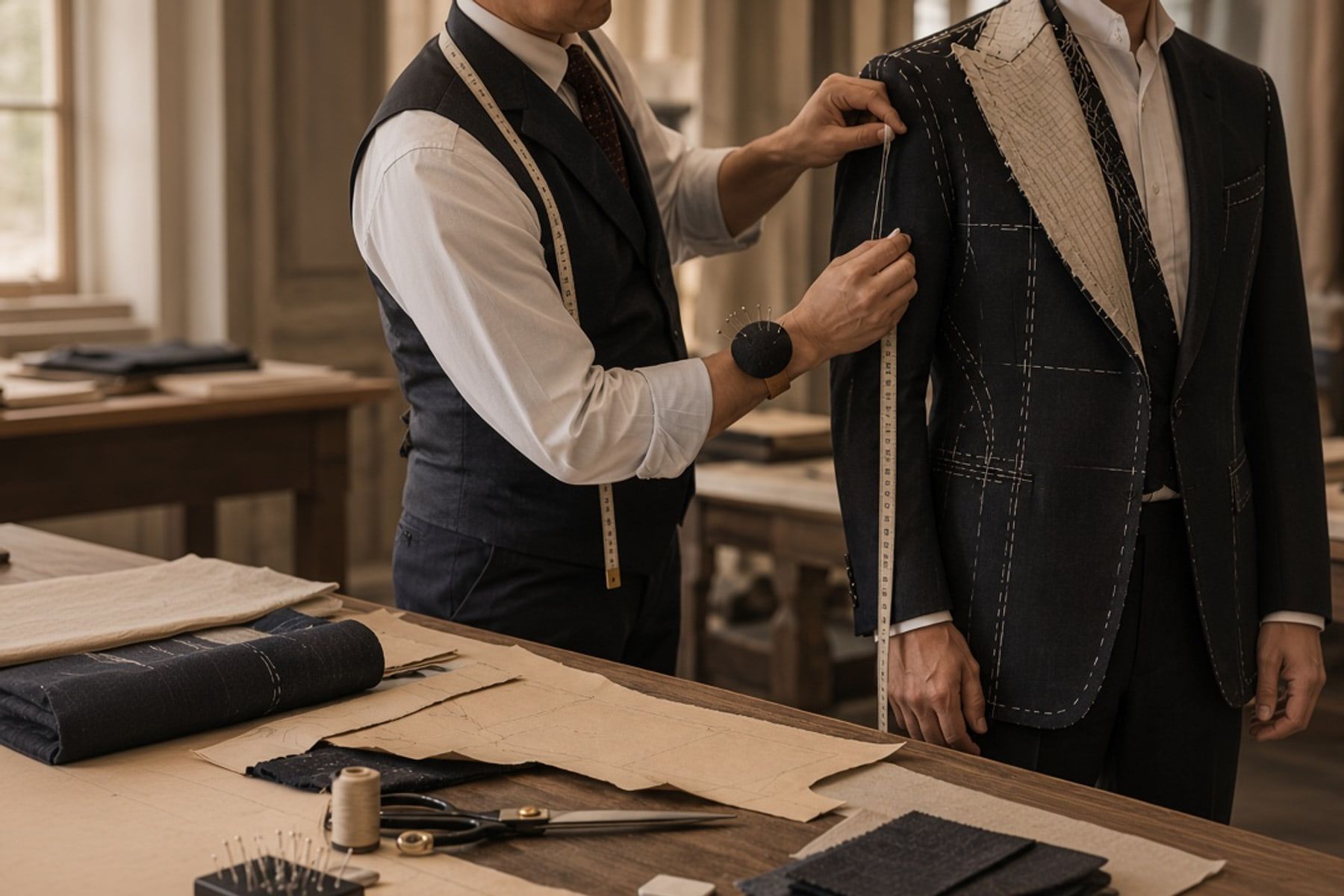
Bespoke and made-to-measure both produce garments for an individual client, but the pattern-making process, fittings and degree of adjustment can be different.
In Singapore those labels are used inconsistently. One house may call a programme bespoke when it starts from an existing block and records a set of measurements. Another may reserve the word for a pattern drafted for one wearer, then altered as fittings show how the cloth sits. “Custom” is broader still and can mean either process, or even ready-to-wear with more extensive alterations.
That is why a buyer is better served by asking how the garment is made than by relying on the word on the door. The useful distinctions are whether an individual pattern is created, what can still be changed after a fitting, how the jacket and trousers are constructed, and how much time the process is given.
This guide sets out the typical differences in pattern, fittings, fit and cost, and how to decide which method suits a wedding, a working wardrobe or a first tailored suit. Houses vary. Treat what follows as a way to compare processes, not as a single standard that every tailor follows.
Bespoke vs Made-to-Measure: The Short Answer
In the stricter sense, bespoke usually starts with an individual pattern cut for one person. Made-to-measure usually starts with an existing pattern or size block, then adjusts selected measurements and style options. Both can produce a well-made suit. They do not give the cutter the same amount of control when posture, shoulder slope or left-to-right balance sit outside the system.
Fittings are part of both methods, but the number of appointments does not by itself prove that a garment is bespoke. What matters is whether those fittings can change the underlying pattern, or only the surface of a garment that was already cut from a base.
Swipe to compare →
| Area | Bespoke | Made-to-measure |
|---|---|---|
| Pattern | Usually an individual pattern | Usually an existing or base pattern, then adjusted |
| Fittings | Usually more extensive | Usually fewer |
| Adjustment | Greater control through the pattern itself | Limited by the base system and what that process can change |
| Style flexibility | Very high, depending on the cutter and cloth | High, but often system-dependent |
| Time | Usually greater | Usually shorter |
| Cost | Usually higher | Usually lower |
These are typical tendencies, not rules. Some made-to-measure programmes include a careful fitting calendar. Because terminology varies, some tailoring programmes described as bespoke may still begin from an existing block. Ask what actually happens to the pattern.
What Is a Bespoke Suit?
A bespoke suit, in the sense used here, is developed around one wearer rather than selected from a finished size run. The process usually begins with measurements and a conversation about how the jacket and trousers should sit: how close through the chest, how the shoulder should feel, how much room is wanted for movement, and how formal the look should be.
From those measurements an individual pattern is created. That pattern is not only a set of lengths. It is a map of balance — how the front and back relate, how the shoulder is sloped, how the chest sits over the waist, how the sleeve hangs from the scye, and how the trousers take the seat and rise. If one shoulder is lower, or the wearer stands with a forward head or a pronounced seat, those points can be written into the pattern instead of being forced onto a standard block.
Fittings are used to test that map. A muslin, basted jacket or test garment lets the cutter see wrinkles, tightness and collapse that measurements alone do not show. The pattern is then refined before the cloth is committed, or after a first garment fitting if the house works that way. Construction — canvas, shoulder, lining, trouser finish — is specified as part of the same brief.
An individual pattern matters because later changes have somewhere to go. If the collar stands away, or the sleeve twists, or the trouser pulls across the seat, the correction can be made in the pattern rather than only by taking in a side seam. That is the practical difference, not the romance of the word.
What Is a Made-to-Measure Suit?
A made-to-measure suit usually begins from an existing pattern or size block. The client is measured, a base size is chosen, and selected points are adjusted: chest, waist, sleeve length, trouser length, sometimes shoulder width or coat length. Cloth, lining, lapel and other style options are still chosen, often from a wide range.
That is a genuine made-for-you process. It is not the same as buying a finished suit and asking for a hem. For a wearer whose proportions sit reasonably close to the house’s blocks, made-to-measure can produce a clean, comfortable result with less time and a lower cost than a fully individual pattern.
The limit is the system. If the block’s shoulder slope, sleeve pitch or seat shape is a poor match, there is only so much a set of graded adjustments can do. The garment can still be well sewn. It may still look smart. It may not solve the specific balance problems that made ready-to-wear fail in the first place.
Made-to-measure is not inherently poor quality. Many clients are better served by a strong MTM programme than by a loosely run process that uses the word bespoke. Compare the actual method, the fittings, and the construction — not the adjective.
How Is the Pattern Different?
A base block is a proven shape for a size. It already contains decisions about shoulder, chest, waist suppression, sleeve hang and trouser rise. Made-to-measure typically edits that shape: longer here, closer there, a different coat length. The architecture of the block remains.
An individual pattern starts from the wearer’s measurements and observed stance. The cutter is deciding where the balance line should fall, not only how much to add or subtract from a standard. That is why two people with the same chest measurement can need quite different coats.
Posture is one reason. A wearer who stands slightly stooped needs more length and cloth in the back of the coat, and a different relationship between collar and shoulder, than someone who stands very upright. Shoulder slope is another. A steep or square shoulder will collapse or lift a standard shoulder line. Chest-to-waist balance matters when the chest is full and the waist is not, or the reverse. Seat shape and rise decide whether trousers clean or pull. Sleeve pitch — the angle at which the sleeve is set — decides whether the sleeve hangs quietly at rest or twists when the arm drops.
Asymmetry is common and easy to miss on a size chart. One shoulder lower, one blade more prominent, a slight difference in arm length: a block treats the body as even unless the system has a way to record those points and the cutter uses it. An individual pattern can build the difference in from the start.
None of this requires specialist vocabulary at the appointment. What you are looking for is whether someone is studying how you stand and how a trial garment hangs, or only filling a measurement card against a size.
How Do the Fittings Differ?
A fitting is not a courtesy visit. Its purpose is to read the cloth on the body: whether the coat is in balance, whether the collar sits on the shirt, whether the sleeve hangs without twisting, whether the waist is clean without locking the wearer in, and whether the trousers sit at the intended rise without pulling across the seat or collapsing at the knee.
In a more involved bespoke sequence, fittings usually happen while there is still enough unfinished garment — or a separate test piece — to change the pattern in a meaningful way. In many made-to-measure programmes, the fitting is closer to a check on a garment that is already largely cut. Small corrections are still possible. Large changes of balance are harder.
The number of fittings alone does not prove the method. A house can book three appointments and still be working from a block that will not accept a real correction. Another can do the necessary work in two if the pattern was sound and the first fitting was read well. Ask what can actually be altered after the fitting, and whether those alterations go back into a pattern that belongs to you.
Does Bespoke Fit Better Than Made-to-Measure?
Bespoke offers more ability to accommodate unusual proportions, posture and asymmetry, but neither method automatically guarantees a perfect fit.
Fit is the product of several things at once: the quality of the measurements, the skill of the person who drafts or adjusts the pattern, how honestly the fittings are interpreted, whether corrections are actually made, the construction of the coat and trousers, and what the wearer prefers to feel. A careless bespoke process can fit worse than a disciplined made-to-measure one.
Where bespoke usually has the advantage is the hard case: a shoulder that ready-to-wear never sits on, a chest and waist that refuse a standard suppression, a posture that throws the collar, a seat that needs rise and cloth that a block does not carry. If standard sizes already sit reasonably well and the brief is simple, made-to-measure may be enough.
Is Bespoke Worth the Extra Cost?
Bespoke can be worth the additional cost when the extra pattern control, fittings and ability to refine proportion meaningfully improve the result for the wearer.
That is the practical test in Singapore as anywhere else. The higher figure is easier to justify when ready-to-wear or a simpler custom programme has already failed to balance, when the suit has to work for a wedding or a demanding professional wardrobe, when posture or proportions sit outside standard blocks, when the styling must be very specific, or when the garment is meant to stay in the wardrobe for years rather than for one season.
Made-to-measure may be the better spend when proportions are standard, the brief is simple, time is short, the budget is tighter, or this is a first custom suit and you want to learn the process without commissioning the most involved version of it. A well-chosen MTM coat worn often is better value than a more expensive garment whose extra control you did not need.
Bespoke is not always better value. Compare what is included in the process, not only the first number. For Perfect Attire’s published starting figures, see Perfect Attire’s current Singapore bespoke suit pricing. Those figures describe one house’s bespoke programme. They are not a market average.
How Much Do Bespoke and Made-to-Measure Suits Cost in Singapore?
Prices vary widely. Cloth and mill, canvas and make, whether the pattern is individual, how many fittings are included, brand, location and the specification of the suit all move the figure. Two programmes that both say “from” a similar amount may not be offering the same garment.
It is not useful to invent a single Singapore market price. Published starting prices at one house cannot be read as the average across the city. A lower opening figure can still be a fair commission if the process matches what you need. A higher one is not automatically better.
If you want a current, house-specific list rather than a guessed range, use Perfect Attire’s published Singapore prices. Use that page to understand one starting point, then ask any tailor you visit what their figure includes: pattern method, fittings, construction and what happens if more adjustment is needed.
Which Singapore Tailors Offer Bespoke Rather Than Made-to-Measure?
There is no reliable public register of which Singapore tailors are “true” bespoke. Terminology varies, and buyers should verify the actual process. An individual pattern, and the ability to alter that pattern during fittings, are stronger indicators than the word “bespoke” alone.
Ask how the first pattern is created, who drafts or adjusts it, whether a test garment or basted fitting is used, and what can still change after that fitting. Two houses can answer those questions differently and both be doing honest work. The risk is not that made-to-measure exists. It is assuming the shopfront word matches the workshop method.
Perfect Attire describes its Singapore process as bespoke, with an individual pattern and fittings used to refine the garment. The showroom sequence is set out on the Singapore bespoke suits page. This article does not rank other houses or claim that competitors misuse the word. For a house-by-house overview of approach and published pricing, see the guide to notable suit tailors in Singapore.
What Should I Ask a Tailor Before Ordering?
These questions work in any showroom. They are more useful than asking whether the house is “really bespoke.”
- Is an individual pattern created for me, or does the process start from an existing block?
- Who creates or adjusts the pattern — and will that person see me at the fitting?
- How many fittings are typical, and what can actually be changed after the first one?
- Is there a muslin, basted coat or other test stage before the cloth is finished?
- Is the garment made in Singapore, elsewhere, or split between cutting and make?
- What construction options are available, and which one is in the published price?
- What happens if further adjustments are needed after the planned fittings?
- How long should I allow from first appointment to delivery, and what delays that?
- What is included in the published price — cloth band, fittings, canvas, trousers, extras?
Write the answers down. If two houses use the same marketing language but give different answers here, you are comparing real processes.
Which Is Better for a Wedding Suit?
Both methods can work for a wedding. Timing, fit and how formal the day is matter more than the label.
Bespoke is useful when proportion and styling need more control: a tuxedo or black-tie evening, a body that has been difficult in standard sizes, or a look that has to hold together with shirt, cloth and formal details. Made-to-measure is useful when the timeline is shorter, the brief is simpler, or the budget is tighter and ready-to-wear already sits reasonably well.
Start earlier than feels necessary. Pattern work, cloth, fittings and small changes of weight or date all take time. For the wedding brief itself — suit or tuxedo, timing and what to bring — see wedding suits in Singapore.
Which Is Better for a Business Suit?
A business suit has to repeat. It will be worn often, sit under a shirt all day, and need to look consistent next to the rest of the wardrobe. Fabric weight and durability matter in Singapore’s climate as much as the cut.
If standard sizing has been close enough and you want greater fabric and styling choice without a more involved fitting process, made-to-measure is often sufficient. If jackets always collapse at the collar, twist in the sleeve or fight the shoulder, the extra pattern work of bespoke is more likely to earn its keep — especially if this coat will be the one you wear three days a week.
Budget still belongs in the decision. A business wardrobe can be built with one carefully fitted bespoke suit and later MTM or ready-to-wear pieces, or the other way around. There is no requirement to commission every working garment the same way.
Bespoke or Made-to-Measure: How to Decide
Choose bespoke if:
- Fit is difficult in standard sizing, or posture and asymmetry keep showing up in ready-to-wear.
- You want the pattern itself to be controllable, not only the finished measurements.
- You value fittings as a way to correct the garment, and you can give the process enough time.
- The styling needs to be specific — including a more formal or unusual brief.
- You are willing to invest more money because the extra control is likely to show.
Consider made-to-measure if:
- Standard proportions already work reasonably well.
- You want cloth and style choice without the full individual-pattern process.
- Time or budget is more constrained.
- This is a first custom suit and a simpler programme is enough to start.
Neither label is a verdict on taste or status. The better choice is the process that matches your body, your calendar and the job the suit has to do. Ask how the pattern is made, what a fitting can change, and what the price includes — then decide.